Get in touch
I'm always excited to take on new projects and collaborate with innovative minds.
Phone
Website
Address
Dhaka, bangladesh
I'm always excited to take on new projects and collaborate with innovative minds.
Dhaka, bangladesh
Cash on delivery, bKash, Nagad, cards or bank transfer — how to choose the right payment methods for your online store in Bangladesh and win more orders.
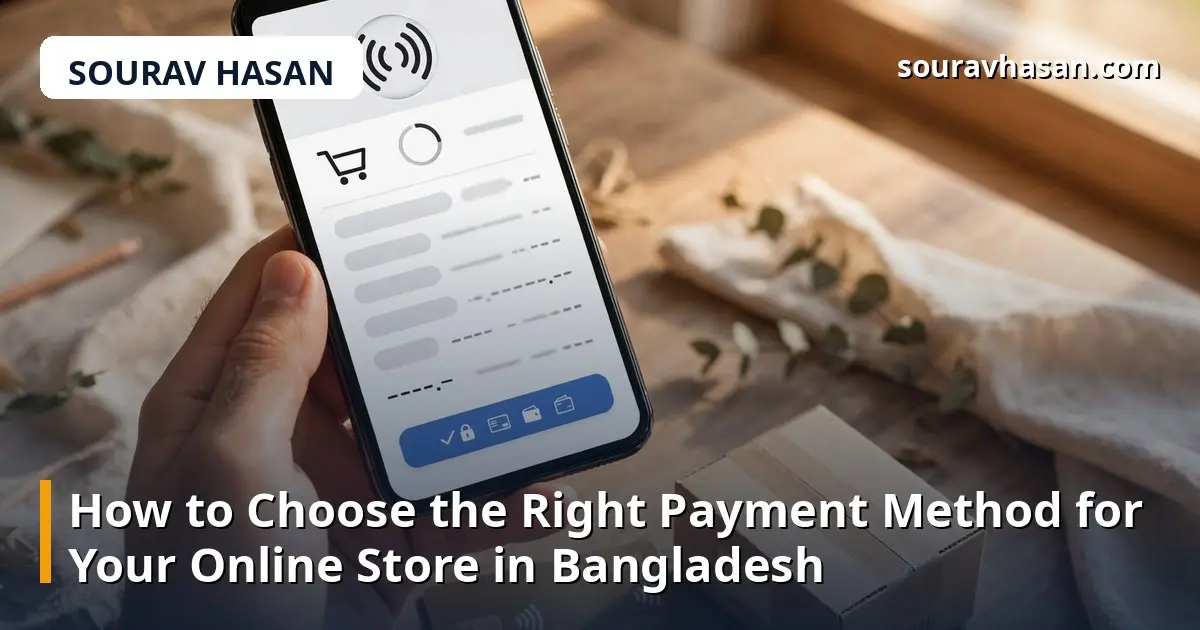
Payment is the moment an online store either wins the order or loses it. A customer who has chosen a product, filled in their address and reached the checkout will still walk away if the payment options do not suit them. In Bangladesh, where many shoppers are still new to paying online, offering the right mix of payment methods is one of the most important decisions a store owner makes.
I run my own e-commerce store, Synex Technologies, and I have seen this first hand. The payment methods we offer shape who orders and how many orders we complete. There is no single right answer for every store, but there are clear principles that help you choose well.
The best payment method for your store is the one your customers already trust. In Bangladesh that usually means cash on delivery first, followed by mobile financial services such as bKash and Nagad, and then cards and bank transfers for higher-value orders. A store that only accepts cards will lose many first-time buyers. A store that only accepts cash on delivery will lose customers who want to pay in advance and get their order faster.
Look at your own orders and your competitors. If most of your customers ask for bKash in your messages, that is a signal. If a large share of your orders come through Facebook, cash on delivery is probably essential, because Facebook shoppers are often buying online for the first time. Match your payment options to the habits of the people who actually buy from you, not to what looks modern.
Cash on delivery, or COD, remains the most trusted payment method for online shopping in Bangladesh. The customer pays only when the product is in their hands, so there is no fear of losing money to a fake store. For a new store with no reputation yet, COD is often the only way to get the first orders at all.
COD has real costs, though. Some customers refuse the parcel on delivery or are not available when the courier arrives, and the store pays the return delivery charge. Fake orders are also more common with COD, because ordering costs the customer nothing. You can reduce this by confirming every COD order by phone or message before dispatch, and by asking for a small advance on high-value orders. My guide on handling returns and refunds explains how to set the policies that protect you when a COD order comes back.
Mobile financial services have changed how Bangladesh shops online. bKash is the most widely used, with Nagad and Rocket close behind. A customer can pay from their phone in under a minute, without a bank account or a card. For the store owner, the money arrives quickly and there is no courier collection to wait for.
Offering mobile payments also reduces failed deliveries, because a customer who has already paid is far more likely to accept the parcel. The trade-off is the transaction fee and the manual work: unless you use a payment gateway, you will be checking your bKash inbox and matching payments to orders by hand. For a small store that is manageable, and it is often worth it for the extra trust it builds. Keep clear records of every payment, including the transaction ID, so that any dispute can be settled quickly.
Cards and bank transfers suit a different kind of customer: people buying higher-value items such as cameras, laptops or appliances, and business buyers who need a proper invoice. A customer spending a large amount usually prefers to pay by card or bank transfer, where the transaction is recorded and traceable.
A payment gateway can bring cards, mobile banking and internet banking together on one checkout page. That is convenient, but gateways charge a percentage of each sale, and setting one up takes time and documents. For a new store, it is often better to start simple — COD plus bKash or Nagad, with bank transfer as an option for large orders — and add a gateway once order volume justifies it.
Offer enough choice that no customer is forced away, but not so much that checkout becomes confusing. For most small stores in Bangladesh, three options cover almost everyone: cash on delivery, one mobile payment such as bKash, and bank transfer or card for larger orders. Display the options clearly on the product page and again at checkout, so customers know how they can pay before they invest time in ordering.
Clarity matters as much as choice. State the delivery charge, the advance policy and the refund process next to the payment options. A customer who understands the process is far more likely to complete the order. My guide on reducing cart abandonment covers the other checkout problems that lose orders, including slow pages and surprise charges.
Whatever methods you offer, keep the basics safe. Never ask a customer to share their mobile banking PIN or OTP — no genuine store ever needs those. Confirm payments only through the official transaction ID or your gateway dashboard. Keep a simple record of every order, payment and delivery, and reconcile it weekly so that missing payments are spotted early.
Write your payment and refund policy in plain language on your website, and honour it. A customer who pays in advance and then waits in silence is a customer who will never order again and will tell others. A short confirmation message when payment is received, and another when the order is dispatched, builds the trust that turns a first order into a repeat one.
It is safe in the sense that you are paid before the customer keeps the product, but it carries the risk of refused parcels and return delivery costs. Confirming orders before dispatch and asking for an advance on expensive items keeps that risk low.
bKash, because it has the widest reach among online shoppers in Bangladesh. Add Nagad as well if your customers ask for it. One mobile option is enough to start; add more when demand is clear.
Not at first. Manual bKash or Nagad payments plus COD work well for a small store. A gateway becomes worthwhile when manual payment matching takes too much time, or when you want to accept cards directly at checkout.
The right payment mix is the one your customers already use and trust. Start with cash on delivery and the mobile payment your buyers ask for most, add bank transfer for larger orders, and introduce a gateway when your volume justifies it. Keep the options clear, confirm every payment promptly and honour your refund policy. Payment is a trust decision as much as a technical one — get it right, and more of the people who reach your checkout will become customers.
Your email address will not be published. Required fields are marked *